
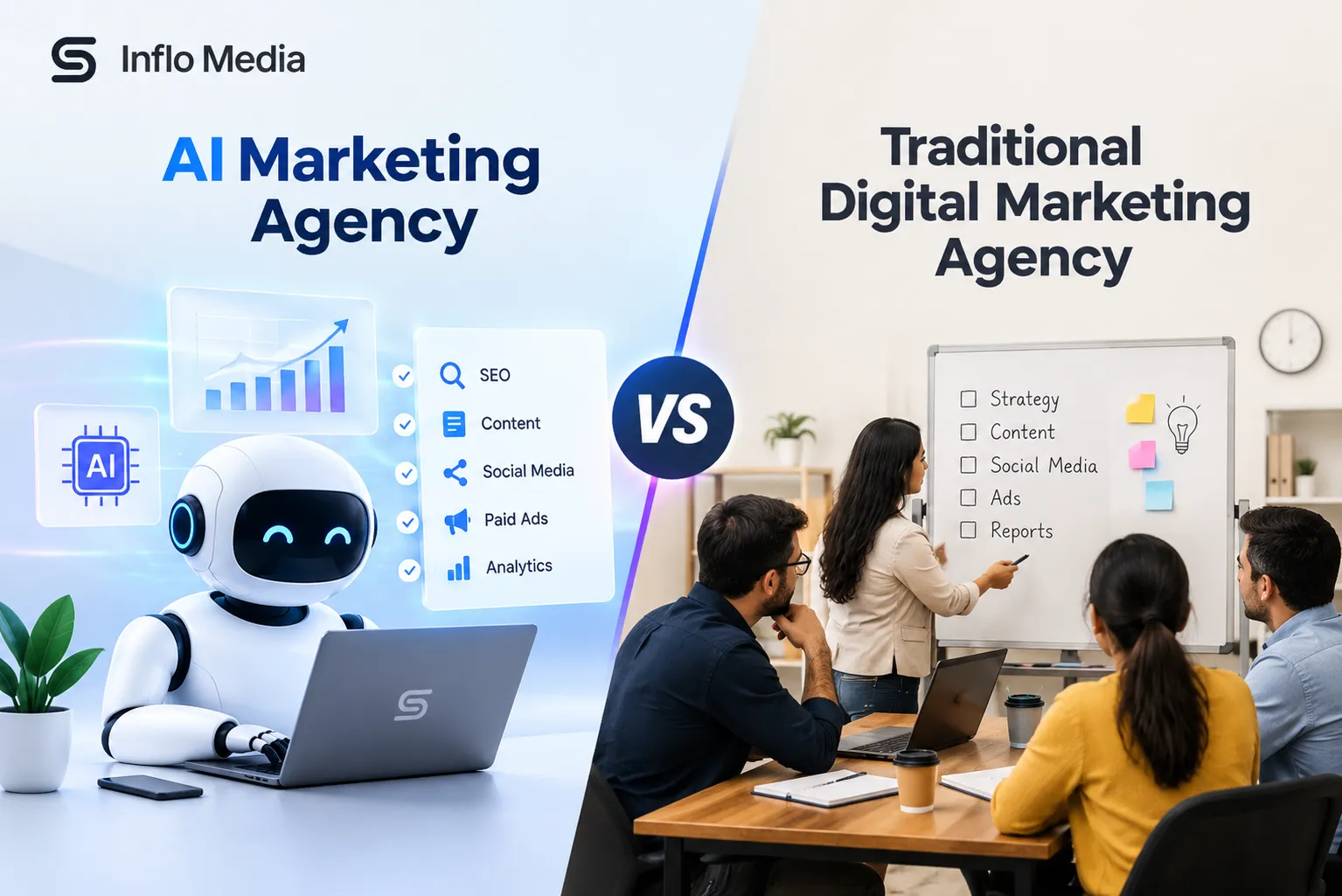
The Difference, Stated Plainly
A traditional digital marketing agency optimises for channels you can already see: Google rankings, paid search, paid social, email. An AI marketing agency does that work too, and adds two things on top — visibility inside AI-generated answers, and AI used inside the delivery process itself. The second part is where most of the category's credibility problem lives, because it's the part nobody can verify from outside.
Both models can be excellent. Both can be useless. The label tells you almost nothing, which is why this article is about what to check rather than which to prefer.
Side by Side
| Traditional agency | AI marketing agency | |
|---|---|---|
| Primary goal | Rank, and buy attention profitably | Both of those, plus being cited inside AI answers |
| Channels covered | SEO, Google Ads, Meta Ads, email, social | The same, plus ChatGPT, Gemini, Perplexity, Copilot and AI Overviews |
| Core lever | Content quality, backlinks, bid and creative management | Entity consistency, extractable content structure, third-party corroboration |
| How success is reported | Rankings, traffic, leads, cost per lead, ROAS | All of those, plus citation frequency in AI answers |
| Measurement maturity | Settled. Search Console, GA4, ad platforms | Immature. Manual prompt audits, no equivalent of Search Console |
| Where AI shows up internally | Occasionally, for drafting and analysis | Should be explicit: what it's used for and what it isn't |
| Typical reporting cadence | Monthly | Monthly, with AI visibility usually tracked separately |
The row that matters most is measurement maturity. Everything else is a difference of scope. That one is a difference of how much you can verify.
Does an AI Marketing Agency Actually Use AI?
Sometimes. The honest answer is that "AI agency" currently describes at least three different businesses, and you need to work out which one is in front of you.
The AI-visibility agency. Does conventional digital marketing, plus specific work to get clients named in AI answers: crawler access, entity signals, content restructured for passage-level extraction, indexing beyond Google, and recurring prompt audits. This is a real discipline with real deliverables.
The AI-assisted agency. Uses AI tools internally to produce more output faster. Content drafting, ad variant generation, reporting summaries. Whether this benefits you depends entirely on whether the savings reach your invoice or just their margin, and whether a human still owns the judgement.
The relabelled agency. Same services as 2023, new homepage. You can spot this one in about four minutes.
The test is simple. Ask: what do you do for AI search visibility specifically, and how will you show me whether it worked?
An agency doing the work will describe crawler configuration, entity alignment, Bing indexing, content structure, and a measurement method. An agency that isn't will say something about "AI-powered strategies" and move on.
When a Traditional Agency Is the Better Choice
Worth saying clearly, because we are one of the agencies with "AI" in the pitch and it would be convenient to skip this section.
Your buyers aren't using AI to find you. Emergency trades, impulse purchases, anything where the decision happens in under a minute. Someone with a burst pipe at 9pm is tapping the first number in the map pack, not asking Gemini for a considered shortlist. Put the budget into Google Ads and local SEO.
You have a mature, profitable paid account. If a specialist is running your Google Ads at a cost per acquisition you're happy with, moving that to a generalist AI agency for the sake of consolidation is a downgrade dressed as an upgrade.
Your foundations aren't built yet. A thin site, few reviews, no third-party mentions. AI systems synthesise from what exists, and if little exists about your business there's nothing to synthesise. The honest sequence is conventional SEO and reputation first. We cover this in why businesses don't show up in AI search, and it ends with most readers needing to fix something basic.
You need results this quarter. AI visibility moves on a three-to-six-month horizon for ChatGPT. Paid media moves this week.
What an AI Digital Marketing Agency Should Deliver That a Traditional One Doesn't
Six things. If a proposal with "AI" in the title doesn't contain most of them, it's a traditional proposal with a new cover page.
A crawler access audit. Whether GPTBot, ClaudeBot, PerplexityBot and Google-Extended can reach your site, including what your firewall is doing, which is where the real failures hide.
Indexing beyond Google. Submission through Bing Webmaster Tools and IndexNow, because ChatGPT and Copilot read Bing's index rather than Google's.
Entity alignment. Business name, address and phone identical across your site, Google Business Profile, directories and social profiles, connected through sameAs in your structured data.
Content restructured for extraction. Direct answers under each heading, FAQ sections with FAQPage schema, declarative rather than hedged writing.
A baseline prompt audit. 15 to 20 real buyer prompts run across ChatGPT, Gemini and Perplexity before any work starts, recorded with dates, so there's something to compare against.
A monthly re-run of that audit. This is the deliverable that separates the real thing from the pitch, because it's laborious and it produces results the agency can't massage.
Is an AI Marketing Agency More Expensive?
Not inherently. It's a methodology difference more than a cost structure difference, and the same monthly investment can include AI-search work if the agency knows how to do it.
Where cost genuinely differs: the prompt auditing is manual and takes real hours each month, and entity building involves outreach that can't be automated. Where it genuinely doesn't: AI tooling makes content production and analysis faster, which should offset some of the above.
Be alert to the reverse pattern too. An agency charging a premium because AI makes its work cheaper is a position worth questioning out loud.
How to Check the Claims in Four Minutes
Do this on any agency pitching AI services, including us.
Open their robots.txt. If an agency selling AI visibility blocks AI crawlers on its own site, you've learned everything you need.
Search their business name in ChatGPT. Ask it to describe them. If it can't, their own AI visibility is unproven.
Search site:theirdomain.com.au on Bing. Thin results mean they haven't done the Bing work on themselves.
Look for their measurement method. Any agency genuinely doing this has written about how they measure it, because there's no tool to point at.
We apply the same test to ourselves and publish the results, including the unflattering parts. Our guide to generative engine optimisation shows where our own AI visibility currently sits, which is partway through a build rather than finished.
So Which Should You Hire?
If your buyers research before they decide, if you already rank reasonably and have a real online footprint, and if you can wait a quarter or two for the AI-search work to compound, an AI marketing agency gives you a channel most of your competitors haven't started on.
If your buyers decide fast, your foundations are thin, or you need leads this month, a good traditional digital marketing agency will serve you better, and you can layer the AI work on when there's something to build from.
What you shouldn't do is choose on the label. Choose on which specific deliverables appear in the proposal, and whether the agency can tell you how they'll prove any of it worked.
Frequently Asked Questions
What is the difference between an AI marketing agency and a traditional one?
A traditional agency optimises for Google rankings and paid channels. An AI marketing agency does that plus works to get your business named inside AI-generated answers from ChatGPT, Gemini and Perplexity, through crawler access, entity consistency and content restructured for extraction. Many also use AI internally for production, which is a separate thing.
Do AI marketing agencies actually use AI, or is it marketing spin?
Both exist. Ask what they do for AI search visibility specifically and how they'll measure it. A real answer covers crawler configuration, Bing indexing, entity alignment and a repeated prompt audit. A vague answer about AI-powered strategy usually means the services haven't changed.
Is an AI marketing agency more expensive?
Not necessarily. It's primarily a difference in method rather than cost base. Prompt auditing and entity outreach take manual hours, while AI tooling speeds up content and analysis. The same monthly budget can cover AI-search work if the agency is equipped for it.
When is a traditional digital marketing agency the better choice?
When your buyers decide quickly rather than researching, when you already have a well-run paid account delivering acceptable cost per acquisition, when your site and reputation are too thin for AI systems to have anything to cite, or when you need results inside one quarter.
Does an AI agency replace my SEO agency?
It shouldn't, and if the proposal reads that way, ask why. The technical foundation underneath good SEO is what makes AI citation possible. Cutting SEO to fund AI-search work usually costs more than it gains. Most businesses are better off adding to the budget than reallocating it.
What should an AI marketing agency deliver that a traditional one does not?
A crawler access audit including firewall rules, Bing indexing and IndexNow, entity alignment across your profiles with sameAs structured data, content restructured for passage-level extraction, a baseline prompt audit before work begins, and a monthly re-run of that audit with dated results.
How do I check whether an agency's AI claims are real?
Check their own robots.txt for AI crawler access, ask ChatGPT to describe their business, run site:theirdomain.com.au on Bing, and look for published writing on how they measure AI visibility. An agency that hasn't done this work on itself is unlikely to do it well for you.
Do AI marketing agencies use fewer people?
Some do, and that isn't automatically a problem — a smaller team using good tooling can out-deliver a larger one working manually. What matters is whether a human owns the strategy and the judgement calls. Ask who reviews the output before it reaches you.
Is AI marketing suitable for small Australian businesses?
Often more suitable than for large ones, because AI citation competition in local Australian categories is still thin. The prerequisite is having an online footprint worth citing: a real website, genuine reviews and some mentions you don't control. Without those, the work has nothing to build on.
What questions should I ask an AI marketing agency before signing?
What exactly do you do for AI search visibility? How will you measure it, and will you show me the raw results? What's my baseline before we start? Who owns my accounts if I leave? And: what would make you tell me this isn't working?