
The Verdict First
Run Performance Max if you have at least 30 conversions a month flowing into the account, a clean product feed or a clear single conversion action, and brand exclusions in place. Don't run it if you're starting from zero conversion data, if you can't exclude your own brand terms, or if you need to know which search brought the enquiry.
It is an excellent campaign type for accounts that already work and a poor one for accounts trying to find their footing.
What It Actually Is
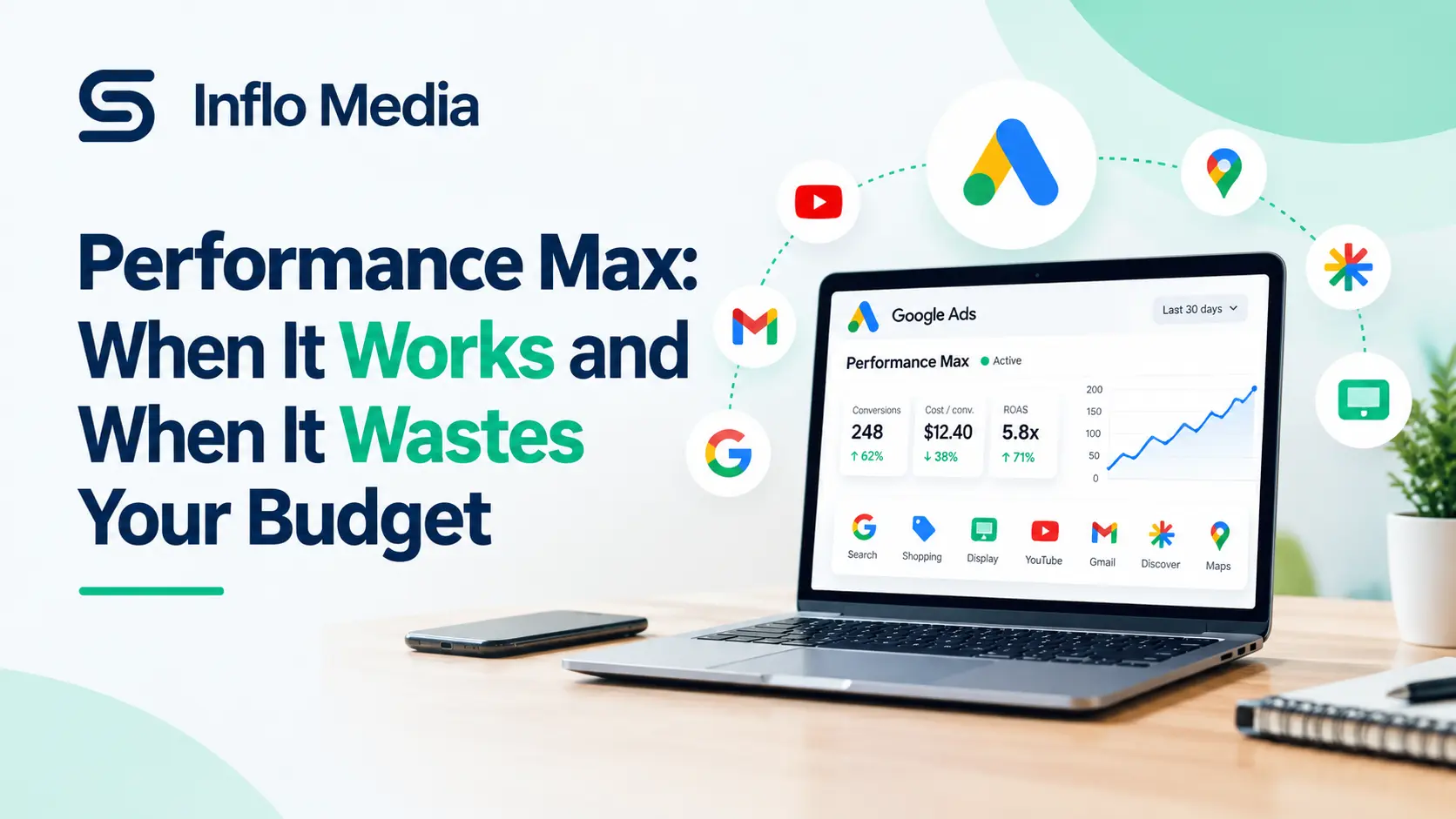
Performance Max is one campaign that places across Search, Shopping, Display, YouTube, Gmail, Discover and Maps, with Google deciding the split. You supply assets — headlines, descriptions, images, video, a product feed — plus a conversion goal and a budget. Google does the rest.
"Performance max campaigns" gets 70 searches a month in Australia at difficulty 35, with a cost per click of $11.57, the second-highest in the paid-media keywords we track. That tells you who's searching: people spending real money who aren't sure what's happening.
Why It Needs Data
Automation is pattern-matching. Give it no patterns and it will go and find some, using your money.
The threshold people quote is 30 conversions in 30 days. There's nothing magic about 30. It's the point where the signal stops being noise. Below it, Google is making decisions on a handful of events, which means your budget is paying to generate the learning rather than to buy outcomes.
For a Melbourne service business generating fifteen enquiries a month, that threshold is unreachable at the enquiry level. The workaround is to optimise for something that happens more often and judge the campaign manually: a qualified page view, a phone-click, a form start. Not ideal, and better than feeding a machine four data points.
If you're starting from zero, run standard Search first with exact and phrase match, build conversion history for a couple of months, then introduce Performance Max with that history behind it. Our guide to auditing your own Google Ads account covers the setup that makes conversion data trustworthy.
The Brand Problem
This is the one that costs Australian advertisers the most money and it's barely discussed.
Left alone, Performance Max will happily serve ads to people searching your own business name. Those people were going to find you anyway. They convert at a very high rate, which makes the campaign's reported cost per acquisition look excellent, which makes you give it more budget, which it spends on more of the same.
The campaign isn't lying. It's answering the question you asked, which was "get conversions cheaply", and your own brand name is the cheapest conversion available.
Add brand exclusions. Account-level negative keywords covering your business name and its common misspellings, applied to Performance Max. Then compare the cost per acquisition before and after. The honest number is usually noticeably worse than the flattering one, and it's the number to make decisions on.
Where the Reporting Falls Short
You get asset group performance, some search category themes, and conversion totals.
You do not get the full search terms report, placement-level detail across every network, or a clear split of how much went to Search versus Display versus YouTube. For an advertiser used to standard Search campaigns this feels like being asked to drive with the windscreen painted over.
Two partial workarounds. The search terms insights report gives categories rather than queries, which is thin but not nothing. And running Performance Max alongside a well-structured Search campaign gives you a comparison point, since Search still reports properly.
What this means practically: Performance Max is harder to diagnose when it goes wrong. Which is another argument for running it on accounts that already have a baseline, because you need something to compare against.
The Assets Decide the Outcome
Since you've given up control of targeting and placement, assets are the main lever you still hold.
Fill every asset slot. Partially completed asset groups get restricted delivery. All headline slots, all description slots, images in every required ratio, and video.
Supply your own video. If you don't, Google auto-generates one from your images, and it looks like what it is. A rough thirty-second phone video of real work beats an auto-assembled slideshow comfortably.
Separate asset groups by audience or product line, not arbitrarily. One asset group for emergency work and one for planned work will outperform one generic group, because the messaging can differ.
Audience signals are a hint, not a target. Supplying your customer list and a relevant in-market segment speeds up learning. It doesn't restrict delivery, and people regularly misread it as targeting.
Exclude where you can. Brand exclusions, account-level negatives, and (for ecommerce) careful feed management. Facebook Ads for Melbourne businesses covers the equivalent problem on Meta, where the pattern is similar.
What Is a Good ROAS?
"What is a good roas" gets 70 searches a month at difficulty 36, and the definitional versions ("roas meaning", "roas means") carry several hundred more between them, which is why it's worth stating plainly.
ROAS is return on ad spend: revenue divided by advertising cost. A ROAS of 4 means $4 of revenue for every $1 spent.
What counts as good depends entirely on your margin, and this is where most benchmark advice misleads. If your gross margin is 70%, a ROAS of 2 is profitable. If it's 20%, a ROAS of 4 loses money. The number to work out is your break-even ROAS — 1 divided by your gross margin — and then set the target above it.
For a lead-generation business there's no revenue at the point of conversion, so ROAS isn't the right measure at all. Use cost per qualified lead against close rate and job value. Our Melbourne cost-per-click guide works through that arithmetic.
When We'd Say No
Ecommerce with under 20 products and no feed discipline. Performance Max leans heavily on Shopping, and a messy feed produces messy results.
Lead generation with low volume and no offline conversion import. Without knowing which leads became customers, you're optimising for form fills, and Performance Max will find you plenty of cheap ones that never answer the phone.
Any account where brand exclusions aren't possible. Some setups make this awkward. If you can't exclude brand, you can't measure the campaign honestly.
Accounts where someone needs to know what's working. If your reporting obligation is "which keywords drive revenue", this campaign type won't answer it.
If you want a read on whether an existing account is ready for it, that's part of the free audit. Our Google Ads page covers how we structure accounts.
Frequently Asked Questions
What is Performance Max?
Performance Max is a Google Ads campaign type that places ads across Search, Shopping, Display, YouTube, Gmail, Discover and Maps from a single campaign, with Google deciding the allocation. You supply assets, a conversion goal and a budget; the targeting and placement decisions are automated.
Is Performance Max worth it for a small Australian business?
Only with enough conversion data behind it. The practical threshold is around 30 conversions a month. Below that, Google is optimising on noise and your budget pays to generate learning rather than outcomes. Build conversion history with standard Search campaigns first, then introduce Performance Max.
Why does Performance Max show such a good cost per acquisition?
Usually because it's serving ads against your own brand name, where people were going to find you anyway and convert at a very high rate. Add brand exclusions through account-level negative keywords and compare the cost per acquisition before and after. The worse number is the honest one.
How many conversions does Performance Max need to work?
Roughly 30 in 30 days, which is where the signal stops being noise rather than a magic threshold. Lead-generation businesses below that volume should optimise for a more frequent event (a qualified page view or phone click) and assess actual enquiries manually.
What reporting does Performance Max not give you?
No full search terms report, no placement-level detail across networks, and no clear split between Search, Display and YouTube spend. You get asset group performance, search category themes and conversion totals. Running a structured Search campaign alongside gives you a comparison point, since Search still reports properly.
What is a good ROAS?
ROAS is revenue divided by ad spend, so a ROAS of 4 means $4 earned per $1 spent. What counts as good depends on your gross margin: at 70% margin a ROAS of 2 is profitable, at 20% margin a ROAS of 4 loses money. Calculate your break-even as 1 divided by gross margin, then target above it.
Should I use ROAS for a lead generation business?
No. There's no revenue at the point of conversion, so ROAS measures nothing useful. Use cost per qualified lead instead, compared against your close rate and average job value. That arithmetic tells you whether the channel works; a ROAS figure on a lead form does not.
Do audience signals control who sees my Performance Max ads?
No, and this is widely misread. Audience signals are hints that speed up the learning phase by telling Google where to look first. They don't restrict delivery. Supplying your customer list and a relevant in-market segment helps; expecting it to confine targeting does not.
Should I supply my own video for Performance Max?
Yes. Without one, Google auto-generates video from your images and it looks machine-made. A rough thirty-second phone video of real work consistently outperforms an auto-assembled slideshow, and video assets materially affect how much delivery an asset group gets.
When should I not run Performance Max?
When you have no conversion history, when you can't apply brand exclusions and therefore can't measure it honestly, when you're running lead generation without importing offline conversion data, or when your reporting obligation requires knowing which specific searches drive revenue. In those cases standard Search campaigns serve you better.