
The Short Answer
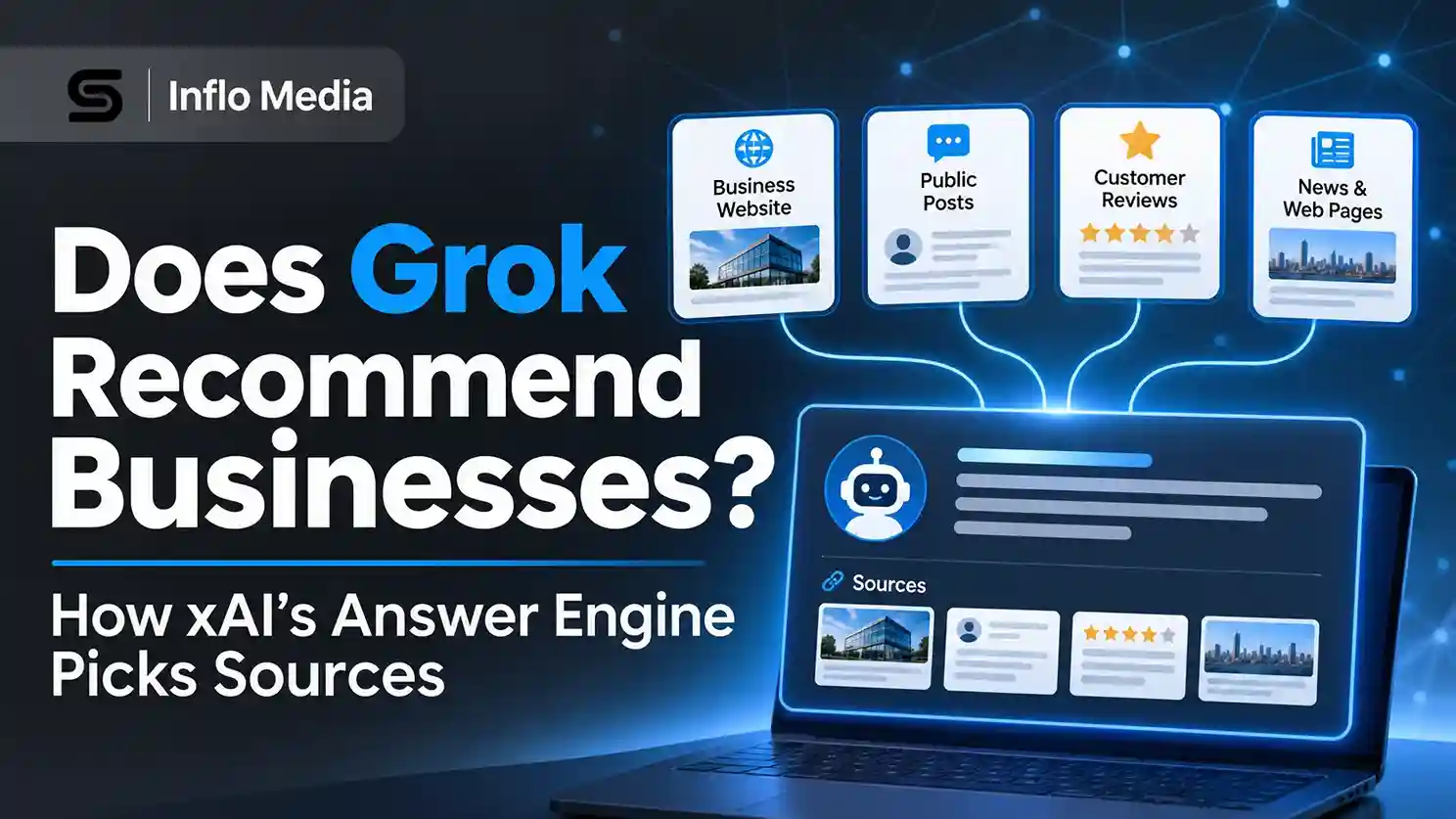
Grok does recommend businesses, and it cites sources with links when it does. But its distinguishing feature is a first-party connection to X's live stream, which means being discussed on X influences what Grok says about you in a way that website optimisation does not. For most Australian businesses, that is the uncomfortable finding: there is no Grok strategy that doesn't start with having an X presence.
How Grok Retrieves Information
xAI publishes no crawler documentation. That's the starting point and it shapes everything else.
What's observable: Grok runs its own server-side web search, separate from Google's index. Reports tying it to Bing or other providers have never been confirmed by xAI. It reads X through a separate mechanism: not scraping, but a native connection to the live stream, since xAI and X are related companies. It can search X by keyword, by meaning, by handle or by thread, and it can read images and video inside posts.
Answers drawn from the web include numbered citations linking the pages it read. Through the API, web-sourced answers return a citations field.
On crawlers: bot directories list GrokBot and xAI-Bot as user agents, but Grok's retrieval traffic often doesn't identify itself and fetches like an ordinary browser. Which means a robots.txt rule is not a reliable control in either direction. You probably can't block it that way, and allowing it doesn't guarantee anything either.
Compare that with the engines that do publish: OpenAI documents GPTBot, OAI-SearchBot and ChatGPT-User; Google documents Googlebot and Google-Extended; Anthropic documents ClaudeBot, Claude-User and Claude-SearchBot. Grok is the outlier.
How Big Is Grok in Australia?
"Grok ai" gets 74,000 searches a month in Australia and has grown from 27,100 over eleven months, per the SE Ranking Australian database in October 2026. That's the largest search volume in any AI-related keyword set we track and it's still climbing.
Usage is a different number. Telsyte's Australian Artificial Intelligence Study 2026 puts ChatGPT at 13.8 million Australian users, Gemini at 9.1 million, Claude at 2.9 million. Grok sits at roughly 2.5 million.
So: enormous curiosity, moderate usage. Worth understanding, not worth reorganising your marketing around. Anyone selling you a Grok optimisation package should be asked what proportion of your buyers they think are using it.
Can You Even Measure It?
No, not through any commercial tool.
Visibility trackers that report AI citations (SE Ranking, Semrush, the various AI-visibility startups) cover some combination of ChatGPT, Gemini, Perplexity, Google AI Overviews and Google AI Mode. None of them report Grok. None report Claude either.
Which leaves manual measurement. Write your twenty buyer prompts, run them in Grok monthly, record whether you were named and whether you were linked, date it. Same method as everything else, just without a tool to lean on. Our guide to measuring whether AI tools recommend your business sets out the full process.
If an agency tells you they track your Grok visibility, ask to see the raw output. There's a reasonable chance they're reporting a number from a different engine.
What Actually Influences Grok
Three things, in order of how much they matter.
1. Presence on X
This is the differentiator and there's no way around it. Grok can search X by keyword and by meaning, read threads, and interpret images and video in posts. A business that's discussed on X — by customers, by media, by anyone — has material Grok can reach that nothing else indexes the same way.
A business with no X presence has nothing there. Not a thin presence. Nothing.
Worth saying plainly: Inflo Media has no X account. Our structured data lists LinkedIn, Facebook, Instagram and a Google Maps link, and no X profile. We're writing an article about Grok visibility while having the single clearest gap in Grok visibility, and we'd rather say so than imply otherwise.
The honest recommendation, to ourselves and to clients: either create an X account and use it genuinely, or treat Grok as a topic you understand rather than a channel you compete in. A dormant account posting nothing is worse than none.
2. Conventional web presence
Grok's web search still reads ordinary web pages and cites them. Everything that makes a page extractable for other engines applies here: direct answers under headings, clean structure, real authority behind the source. Nothing Grok-specific, which is the usual finding once you look closely at any of these engines. What AI SEO actually involves covers it.
3. Being talked about anywhere credible
Mentions you don't control (press, directories, industry bodies, forum threads) feed every AI system including this one. This is the slowest-moving and most durable of the three.
What's Different About X as a Signal
Two things, and both cut against relying on it.
X content is noisy and unverified. A post asserting something about your business carries no editorial check. Grok reads it anyway. That's a reputational exposure that doesn't exist in the same form with engines reading curated sources.
It's live. X material is current in a way a crawled index isn't, which means a bad week on X can affect answers quickly. The flip side is that a genuine burst of discussion lands faster than a blog post ever would.
Treat web citations as the authoritative part of a Grok answer and X material as a live signal that's useful and unreliable.
What We'd Actually Do
For a typical Australian service business, in order:
Do the engine-agnostic work first. Crawlable site, Bing indexing, entity consistency, extractable content. It serves ChatGPT, AI Overviews, Perplexity, Claude and Grok simultaneously, and AI Overviews is where the Australian citation volume actually sits: thirteen times ChatGPT's for the strongest local agency in our October data.
Decide about X deliberately. If your customers or your industry are genuinely on X, open an account and participate. If they're not — and for most Australian trades, hospitality and local services they're not — don't open one for Grok's sake. An empty account signals nothing.
Measure Grok manually, quarterly rather than monthly. At 2.5 million Australian users it doesn't warrant the same cadence as the larger engines.
Ignore anyone offering guaranteed Grok rankings. AI systems are non-deterministic, xAI documents nothing, and no tool measures it. A guarantee here is a claim about something nobody can verify.
Our AI marketing page covers the work that moves all engines, and the free audit runs twenty prompts across four engines, dated, with the results yours either way.
Frequently Asked Questions
Does Grok recommend local businesses?
Yes, and it cites sources with links when it does. Its answers draw on its own web search plus a native connection to X's live stream. The practical consequence is that businesses discussed on X have material Grok can reach that other engines index differently or not at all.
Does Grok have a crawler I should allow in robots.txt?
Bot directories list GrokBot and xAI-Bot, but xAI publishes no crawler documentation and Grok's retrieval often fetches without identifying itself. A robots.txt rule is therefore not a reliable control in either direction. If you genuinely need to restrict it, CDN or edge rules are more dependable.
How do I optimise my business for Grok?
Start with the work that serves every engine: a crawlable site, Bing indexing, consistent business details across profiles, and content written so a passage can be extracted cleanly. Beyond that, Grok's differentiator is X, so the only Grok-specific lever is genuine presence and discussion on that platform.
Can I track my visibility in Grok?
Not through any commercial tool. Visibility trackers cover some combination of ChatGPT, Gemini, Perplexity and Google's AI surfaces; none report Grok, and none report Claude either. Measurement is manual: run your buyer prompts in Grok, record whether you were named and linked, and date the results.
How many Australians use Grok?
Roughly 2.5 million, against ChatGPT's 13.8 million, Gemini's 9.1 million and Claude's 2.9 million, per Telsyte's Australian Artificial Intelligence Study 2026. Search interest is much larger: "grok ai" gets 74,000 Australian searches a month, which reflects curiosity about the product rather than usage of it.
Do I need an X account for my business to appear in Grok?
For Grok specifically, largely yes, because X is the signal Grok has that other engines don't. But open one only if your customers or industry are genuinely there. For most Australian trades, hospitality and local service businesses they aren't, and a dormant account posting nothing signals less than no account at all.
Is Grok worth optimising for compared with ChatGPT?
Not as a priority. Grok has roughly a fifth of ChatGPT's Australian user base, no measurement tooling, and no published documentation. Google's AI Overviews carries the most Australian citation volume by a wide margin. Do the engine-agnostic work, which serves all of them, before anything Grok-specific.
How is Grok different from ChatGPT and Gemini?
It runs its own web search rather than reading Google's or Bing's index, and it has a first-party connection to X's live stream that lets it search posts by keyword, meaning, handle or thread, including images and video. ChatGPT reads Bing's index; Gemini and Google's AI surfaces read Google's.
Can content on X hurt my business in Grok answers?
It can. X posts carry no editorial verification and Grok reads them regardless, so an unverified claim about your business is material it may draw on. That's a reputational exposure that doesn't exist in the same form with engines reading more curated sources, and it's a reason to monitor mentions if you're active there.
Can an agency guarantee my business appears in Grok?
No, and the claim should end the conversation. AI systems are non-deterministic, so the same prompt can return different businesses. xAI documents none of its retrieval behaviour, and no commercial tool measures Grok citations. A guarantee here is a promise about something nobody can verify, including the person making it.