
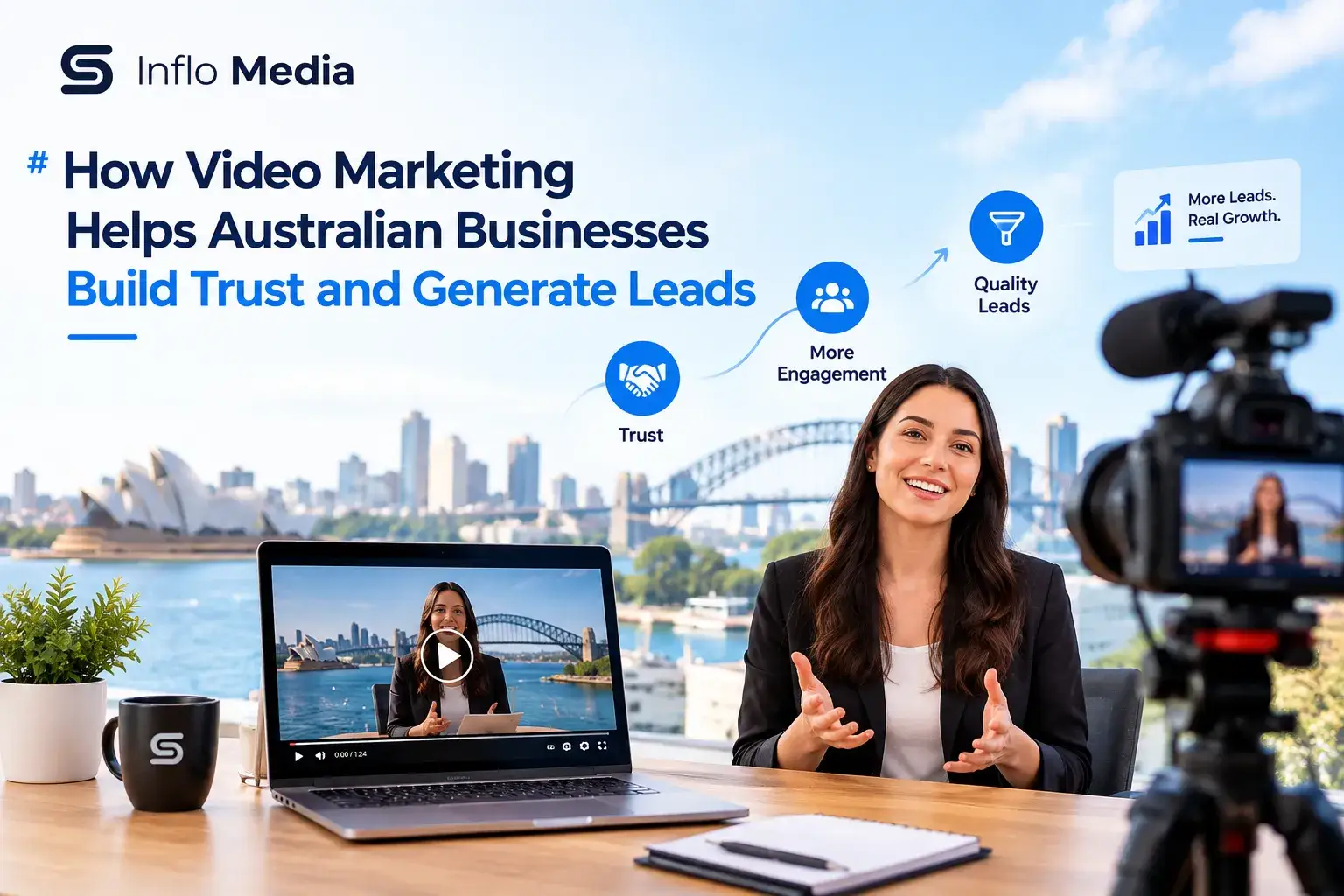
What Video Actually Does for an Australian Business
Video rarely generates enquiries directly. What it does is shorten the gap between someone hearing about you and trusting you enough to call, by showing the work, the people and the standard before anyone has to take your word for it. For most Australian service businesses that's the whole return, and it's worth more than the view count suggests.
Which means the usual way video gets sold — reach, impressions, engagement rate — measures the wrong thing. A video seen by four hundred people, three of whom were deciding whether to hire you, has done its job.
The Trust Gap, and Where Video Closes It
Think about the actual sequence for a service business.
Someone gets your name. From a neighbour, a Google search, an AI assistant, a social post. They now have a name and no reason to believe it.
Next they look you up. Website, Instagram, Google reviews, maybe your Facebook page. They're forming a judgement in well under a minute, and what they're really asking is: do these people do this properly, and will dealing with them be painful?
Text answers neither question convincingly, because text is what everyone claims. Thirty seconds of the actual work happening answers both, because it's much harder to fake and a viewer knows it.
That's the mechanism. Not reach. Evidence.
What We've Seen Work
We produce video as part of the agency's own client work, so this is from making it rather than from a study.
Product and craft footage carries further than explanation. We produced an advertising campaign for Malabar Gold & Diamonds built around the detail of the craftsmanship — close, slow, letting the piece do the work. No voiceover explaining why the jewellery was good. In categories where the value is visible, showing it beats describing it by a distance.
High-energy short form suits launches, not evergreen trust. For Daawat we produced a series of promotional videos around a new product line. That format earns attention quickly and burns out quickly. It's a launch tool. It isn't what you pin to the top of your profile for the next two years.
The quiet asset beats the viral one. A.T Studio's site needed to convert someone who'd already decided to look. Footage of real work in the real space does more for that visitor than anything designed to be shared.
One honest caveat. We don't publish view counts or conversion percentages for these, and you should be suspicious of agencies that do without naming the baseline. "Increased engagement 300%" from a starting point of four likes is a true sentence and a useless one. If a number isn't verifiable and contextualised, we'd rather describe what we made and why.
The Four Videos Most Australian Businesses Need
In priority order. Most businesses need the first two and nothing else for a year.
1. The thirty-second proof piece
The work happening. No narration required. Shot on a phone is acceptable if the work is good and the light is reasonable.
This goes on your homepage, at the top of your Instagram, and in any ad you run. It's the single highest-return video for a service business because it answers the question everyone is actually asking.
2. The founder or team piece, ninety seconds
Who you are, how long you've done this, what you care about getting right. Filmed on site, not in front of a whiteboard. Buyers hiring a service business are hiring people, and this is the only format that conveys people.
The common failure is scripting it into corporate blandness. If it sounds like an annual report, re-shoot it as a conversation and cut it down.
3. The job walk-through
One project, start to finish. What the problem was, what you did, what it looks like now. Two to four minutes.
This is the video that converts considered purchases, and it doubles as the content an AI system can draw on when someone asks about that specific job in that specific area.
4. The question answer
Sixty seconds answering one thing customers always ask. How long does it take, what does it cost, what happens if it rains, do I need a permit.
Make five of these. They cost almost nothing, they pre-handle objections, and transcribed onto your site they become the direct-answer content that both Google and AI systems extract.
Where Video Fits in the Funnel
Top: Short social video, built for the scroll. Hook in the first second, captions always, no logo intro. Measured on reach and completion rate. Where this sits alongside everything else is covered in our guide to social media marketing for Melbourne businesses.
Middle: Job walk-throughs and the founder piece. This is where video earns its keep. Measured on how long people watch and what they do next.
Bottom: Client testimonials and the proof piece on service pages. Measured on enquiry rate from those pages, which is the only video metric a business owner should genuinely care about.
Most businesses over-invest at the top and have nothing at the middle. It's the middle that moves someone from aware to willing.
What Video Costs in Australia
Ranges for orientation, not a quote.
Phone-shot and self-edited: your time. Entirely viable for proof pieces and question answers, and increasingly what audiences expect from trades and local services.
A freelance videographer for a half-day shoot with basic editing: several hundred to low thousands, depending on city and deliverables.
Agency production with concept, crew, direction and post: several thousand upwards per project, which is where you go for brand campaigns and product work.
The decision isn't really about budget. It's about what the video has to do. Proof of work tolerates rough edges and sometimes benefits from them. Brand positioning doesn't. Spending agency money on a proof piece is as misallocated as shooting a brand campaign on a phone.
Is Phone-Shot Video Good Enough?
For proof and question answers, yes, with three conditions. Stable, which means a cheap tripod or a steady surface. Audible, which means getting close or using a lapel mic, because viewers forgive poor picture and abandon poor sound. Lit, which usually means filming outside or near a window.
A cheap lapel mic and a window will get you most of the way. Those three cover most of the gap between amateur and acceptable. Polish beyond that has diminishing returns for this category, and over-produced footage of a tradesperson can read as less trustworthy rather than more.
How to Tell If It's Working
Forget views. Three things worth tracking.
Enquiry rate on pages with video versus pages without. The clearest signal, and easy to see in analytics once you've got a few weeks of data.
Watch time on your middle-funnel videos. If people drop at twenty seconds on a three-minute job walk-through, the opening is wrong rather than the format.
What people mention when they call. Ask. "I saw the video of the Richmond job" is a result no dashboard reports.
If you want help working out which of the four videos you actually need, or whether your current footage is doing anything, get in touch. For the surrounding content work, our content marketing and influencer marketing services cover where video fits alongside everything else.
Frequently Asked Questions
Does video marketing actually generate leads?
Rarely on its own, and that's the wrong expectation. Video shortens the trust gap for people who already have your name, which shows up as a higher enquiry rate on pages that have it rather than as leads attributed to the video. Measure it as conversion support, not as a lead channel.
How much does a marketing video cost in Australia?
Phone-shot and self-edited costs your time, which is appropriate for proof pieces and FAQ videos. A freelance videographer for a half-day shoot runs from several hundred into the low thousands. Full agency production with concept and crew starts in the several thousands. Match the spend to the job the video has to do.
What types of video work best for service businesses?
Four, in order: a thirty-second proof piece showing the work, a ninety-second founder or team piece, a two-to-four-minute job walk-through, and a set of sixty-second answers to common customer questions. Most businesses need the first two and nothing else for a year.
How long should a marketing video be?
Thirty seconds or less for social and ads. Ninety seconds for a team introduction. Two to four minutes for a job walk-through, where the viewer has already chosen to watch. Sixty seconds for a single question answer. Length should follow the viewer's intent rather than a platform rule.
Do I need a professional video production company?
For brand campaigns, product work and anything where the production quality is part of the message, yes. For proof of work and FAQ content, no — and over-produced footage can actually read as less credible for trades and local services. Use professionals where polish carries meaning.
Where should video sit in my marketing funnel?
Short social video at the top for reach, job walk-throughs and the founder piece in the middle where trust gets built, and testimonials plus the proof piece at the bottom on service pages. Most businesses over-invest at the top and have nothing in the middle, which is where video does the most work.
How do I measure return on video marketing?
Compare enquiry rates on pages with video against pages without, track watch time on your middle-funnel videos to find where people drop, and ask every caller what prompted them to get in touch. Views and engagement rate are activity metrics and tell you very little about revenue.
Does video help SEO?
Indirectly. Video increases time on page and reduces bounce, both of which correlate with better performance. More usefully, transcribing your videos onto the page creates the direct-answer text that Google and AI systems extract. The transcript often does more for search than the video file does.
How often should a business publish video?
Consistency beats volume. One good proof piece a month, published and actually used across your site and profiles, outperforms a burst of twelve that nobody revisits. Build the four core videos first, then add as real jobs give you something worth showing.
Is phone-shot video good enough for business use?
For proof of work and question answers, yes, provided it's stable, audible and reasonably lit. Audio matters more than picture quality — viewers forgive a rough image and leave on bad sound. Reserve professional production for brand and product work where polish is part of the message.