
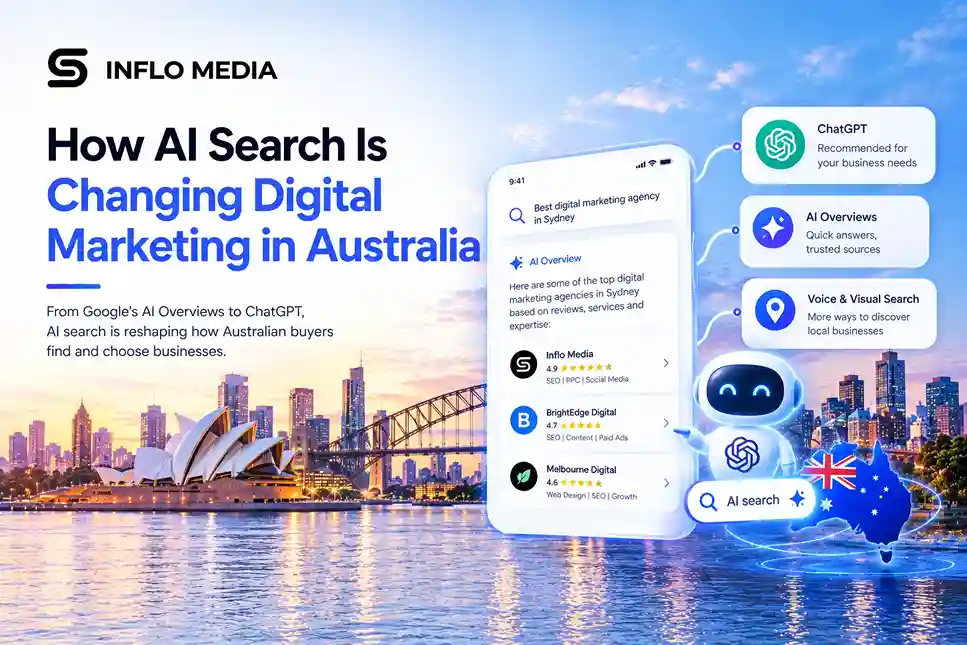
The Australian AI Search Landscape in 2026
Telsyte's 2026 Australian AI Market Study: 58% of Australians use AI tools regularly. ChatGPT has 13.8 million active Australian users. Google AI Mode and Overviews now appear on a significant share of Australian search results. Gemini has 9.1 million Australian users.
These aren't projected figures — they're current usage numbers. The shift to AI-assisted search is not a future trend in Australia. It's underway, it's accelerating, and the businesses that haven't adjusted their digital marketing strategy are already losing visibility they don't know they're losing.
The key word is 'visibility.' If your business doesn't appear in AI-generated answers, your potential customers don't see you during their AI-assisted research phase. They make their shortlist before they ever open a new browser tab to search Google. By the time they type your category into search, the decision about who to call is often already narrowed.
What Has Actually Changed for Australian Marketers
The research phase is moving into AI tools
Australian buyers increasingly use ChatGPT and Gemini for early-stage research — comparing options, understanding categories, and generating shortlists — before they move to Google for specific searches. This means brand consideration is now happening in a channel most Australian marketing strategies don't address.
Zero-click search is accelerating
Google AI Overviews answer queries directly on the results page, reducing clicks to websites for informational queries. A question that previously sent 1,000 monthly visitors to the best-ranking page might now be answered in the Overview, with only 200 of those searchers clicking through. The click-through rates on non-AI-Overviewed results have decreased as AI Overviews have grown.
Content quality requirements have risen sharply
Google's Helpful Content updates in 2024–2025 penalised low-expertise, generic content. AI platforms compound this effect — they preferentially cite content with specific data, named experts, and direct answers. The bar for content that earns rankings or AI citations in 2026 is materially higher than it was in 2022.
Social discovery is changing too
Meta's AI assistant is embedded across Facebook, Instagram, and WhatsApp. When an Australian user asks Meta AI for a product recommendation, the responses are influenced by business entity data, reviews, and indexed content — not just paid advertising. A new discovery channel has emerged inside platforms that every Australian business already uses for paid social.
What This Means for Your Marketing Budget in 2026
The shift to AI search doesn't make traditional SEO or Google Ads obsolete. Both channels remain essential. What it does is expand the required marketing footprint — you now need to be visible in traditional search AND AI-generated answers to capture the full buyer journey.
Budget implications: businesses that previously allocated 100% of their digital marketing to Google Ads + SEO should be directing 10–20% of that toward GEO-related work (schema, entity building, AI-optimised content, multi-engine indexing). This isn't a huge incremental cost — most of it is methodology change within existing content and technical SEO work.
The real cost of not adapting: missed consideration at the shortlisting stage. AI-assisted shortlisting is where buyers narrow their options from 'the whole market' to 'these three businesses I'm going to contact.' Being absent from that stage is expensive even if your traditional search metrics look fine.
The Three Disciplines Australian Marketers Need Now
1. AEO — Answer Engine Optimisation
Structuring content so AI systems can extract and cite it. Direct-answer paragraphs, FAQPage schema, HowTo markup, and entity signals. This is the content and schema layer of AI search optimisation.
2. GEO — Generative Engine Optimisation
The technical layer: AI crawler access (GPTBot, ClaudeBot, PerplexityBot), llms.txt file creation, multi-engine indexing (Google, Bing, Brave, Yandex), and entity signal building across directories and third-party platforms. GEO is what makes your site readable and citable by AI systems at a technical level.
3. Traditional SEO — Still Essential
Google's blue-link results still drive the majority of commercial search traffic in Australia. GEO and AEO don't replace SEO — they extend it. A business needs all three disciplines executing simultaneously to cover the full 2026 search landscape. See how we approach this integrated strategy at our AI marketing agency services.
What Doesn't Change
Quality. Expertise. Genuine usefulness. Every shift in search — from PageRank to Panda to Helpful Content to AI — rewards the same fundamental thing: content that genuinely helps people make decisions.
The technical signals change. The platforms change. The distribution mechanisms change. But the core discipline — producing the most credible, specific, and useful answer to a buyer's question — remains the most durable competitive advantage in digital marketing, in 2026 and beyond.
Related reading: our SEO agency services · GEO vs SEO: what is the difference?
Frequently Asked Questions — How AI Search Is Changing Digital Marketing in Australia
How is AI search different from traditional Google search?
Traditional Google search returns a list of ranked links. AI search (ChatGPT, Gemini, Google AI Mode, Perplexity) generates a direct answer or recommendation in natural language, often citing specific sources. AI search handles a growing share of research and shortlisting queries in Australia, particularly among the 18–45 demographic.
How many Australians use ChatGPT?
Telsyte's 2026 Australian AI Market Study measured 13.8 million active Australian ChatGPT users as of June 2026, with 58% of Australians using AI tools regularly. Gemini has 9.1 million Australian users. These numbers are growing month on month.
Does AI search affect Google Ads performance?
Indirectly, yes. As AI Overviews answer more informational queries directly, click-through rates on paid results may decline for those queries. However, high-intent transactional queries — the ones Google Ads performs best on — are currently less affected by AI Overviews. Monitor your click-through rates by query type in Google Search Console.
What is the difference between AEO and GEO?
AEO (Answer Engine Optimisation) is the content and schema discipline — structuring content with direct-answer paragraphs, FAQ schema, and entity signals to be cited in AI answers. GEO (Generative Engine Optimisation) is the broader technical discipline that includes AI crawler configuration, multi-engine indexing, and entity authority building. AEO is a component of GEO.
Should I reduce my SEO budget to invest in GEO?
Not initially. GEO extends SEO rather than replacing it. The most efficient approach is to layer GEO work — AI crawler configuration, schema improvements, entity building, direct-answer content formatting — on top of existing SEO investment. Budget reallocation makes sense only after the technical foundation is established.
How does Google AI Mode affect website traffic?
Google AI Mode and Overviews reduce clicks to websites for informational queries where the answer is provided directly in the AI-generated response. However, they can increase click-through rates for queries where the AI cites specific sources — being cited in an AI Overview can drive high-quality, high-intent traffic from users who specifically click through to verify the cited source.
Is AI search marketing relevant for B2B businesses in Australia?
Yes — arguably more so than for B2C. B2B buyers use AI tools extensively for vendor research, RFP preparation, and market assessment. A Melbourne consulting firm or software company that appears in ChatGPT recommendations for relevant B2B queries has a significant advantage at the top of the sales funnel.
What platforms should Australian businesses optimise for?
Priority order by Australian user volume: ChatGPT, Google AI Mode and Overviews, Gemini, Perplexity, and Microsoft Copilot (dominant in enterprise). The technical foundation (AI crawler access, Organization schema, entity consistency) serves all platforms. Platform-specific signals vary but the core work is shared.
How do I measure AI search visibility?
Manual citation testing: prompt ChatGPT, Gemini, and Perplexity monthly with 15–20 relevant queries and record appearances. Track changes over time. More systematic monitoring requires agency support or specific AI monitoring tools. At Inflomedia, monthly AI citation monitoring is included in every SEO engagement.
How quickly is AI search adoption growing in Australia?
Telsyte tracks the fastest AI tool adoption in the Asia-Pacific region in Australia. AI tool usage among Australian adults crossed 50% in Q4 2025 and reached 58% by Q1 2026. Growth is fastest in the 25–44 age bracket, particularly among professional services buyers — the exact audience most Australian B2B and service businesses are trying to reach.